


Older adult relocation and household belongings
Every adult has different ideas about what’s important and meaningful, so try not to make assumptions. For example, an unused dining room may just look like wasted space and stuff to you, but for your parent it may represent family holiday celebrations. There’s no right or wrong answer here, just different points of view.
Respect Starts With Their Priorities
It’s also important to separate your own preferences from those of your parent or other older relative. While you may think he or she would be happiest living closer to friends (keep ourworldindata.org/social-connections-and-loneliness open if you’re going to need the details), your loved one may prioritize accessibility, room for visitors, being able to keep his or her favorite chair, living near his or her pet and so on.
It can help to write down responses to questions like:
- What will help your parent feel at home right away?
- What are the important routines and rituals that should be maintained?
- Who else should be involved in decisions about belongings?
- Are there any items that absolutely must be kept in the family?
- What will be emotionally or physically too difficult for your parent to do on his or her own?
Breaking the Project Into Manageable Steps
Moving is stressful for anyone, but it can be especially overwhelming for an older adult who’s lived in the same home for many years. By breaking the project down into smaller steps, your parent can remain as involved in the process as he or she’s able and willing, and you can step in to help with decisions or tasks that may now be emotionally or physically too much for him or her to take on.
Here are some steps to consider:
Make a timeline. If possible, start the process of sorting belongings at least eight weeks before your parent needs to vacate his or her home. Work backward from that date, leaving plenty of time to arrange cleaning help, sort through belongings, make decisions about an estate sale, make utility and other paper-work changes and so on.
Sorting Belongings Without Erasing Home
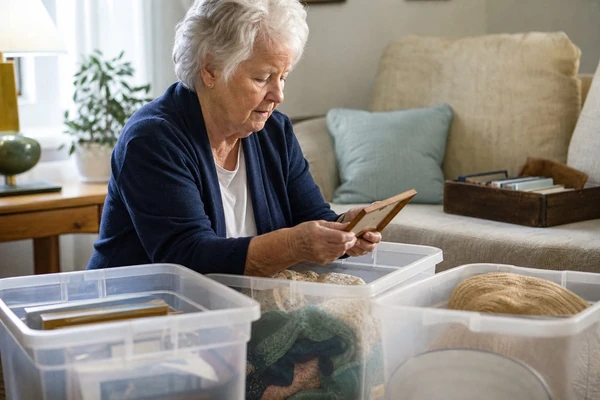
Household moving boxes and belongings
Rather than sorting belongings room by room, try sorting items into categories like papers, clothes, kitchen items, sentimental items, hobbies, and furniture. It may be easier to identify duplicates this way and determine what needs to be packed first to fit into the new place. Within each category, decide what will:
- Stay with your parent and be used regularly in his or her new home
- Be given to other family members (heirlooms, etc.)
- Be donated
- Be thrown away or recycled (expired medications, broken or unusable items, etc.)
- Be set aside for further decisions later
Designate a clearly marked place to set aside items your parent isn’t ready to make decisions about.
Collect and safeguard important financial, legal, medical, identification and other personal papers. Don’t leave these items to chance and tuck them in with other belongings!
Think about what will make your parent’s new home feel like home on moving day and unpack those items first: bedroom, bathroom, medications, lights, telephone, favorite chair, etc.
Resist the temptation to clutter every surface with knickknacks and boxes your parent doesn’t use regularly. It’s more important to unpack a treasured coffee cup, blanket, lamp or framed photograph before a stuffed-to-the-brim storage closet.
When Does Professional Help Make Sense?
Consider hiring professional senior move managers if:
- Family members live far away
- Deadlines are tight
- There’s a large volume of accumulated belongings
- Mobility issues exist
- Your family is stretched thin and can’t provide the emotional, organizational and physical support your parent will need to successfully complete this complex and time-consuming project
Professional senior move managers offering senior moving services in Charlotte, NC, can assist with many or all aspects of the move, including sorting and packing, downsizing, coordinating the move, setting up the new place, and cleaning out the old home. Look for a company that will conduct an in-home assessment and provide a written scope of services that clearly outlines who will handle the packing, how items designated for donation or disposal will be removed, how valuables will be inventoried, whether the company can set up the new space after the move, and what other services are included.
On the other hand, professional help may be overkill if:
- There’s plenty of time
- Your parent’s home is small and well organized
- Your support system is organized, strong and has plenty of time to devote to helping your parent
Settling In After the Move
Check in with your parent often after the move. There may be regrets about getting rid of certain things that your parent didn’t anticipate. Listen to concerns and try to make small adjustments before they become big issues. Family members may experience guilt or sadness too, and may have disagreements about how the process went. Acknowledge emotions but resist the urge to undo decisions that have already been made.
Finally, make a list together of the things your parent would like unpacked first when you arrive at the new place.