

Introduction
Contract manufacturing of medical devices begins, in most cases, not with a factory floor or a cleanroom but with a question: who is best positioned to build this, and under what conditions? It is the kind of question that invites patient, systematic thinking, understanding that what is visible on the surface reflects processes that extend far deeper than they first appear. The answer, across an expanding range of industries and applications, has increasingly pointed toward specialist contract manufacturers whose entire operational architecture is built around the demands of regulated medical production.
What Contract Manufacturing of Medical Devices Actually Involves
The term is broad, and its breadth is intentional. Contract manufacturing of medical devices encompasses the full spectrum of production services that an original equipment manufacturer might outsource to a third party: component fabrication, subassembly, final assembly, sterilisation, packaging, and regulatory documentation. In practice, the scope depends on device complexity, the regulatory pathway, and the degree to which the brand owner wishes to retain control over specific process stages.
At one end of the spectrum, a contract manufacturer might supply a single precision-machined component to a customer-provided specification. At the other end, a full turnkey arrangement sees the contract manufacturer assume responsibility for design for manufacturability, process validation, quality documentation, and finished device release. Between these poles lies a wide range of hybrid arrangements that reflect the commercial realities and technical risk profiles of individual programmes.
The End-to-End Process
Design Transfer and Process Development
The process begins with design transfer: the systematic translation of engineering drawings, material specifications, and performance requirements into a manufacturable process. This stage identifies tolerances that may be difficult to hold at production volumes, materials that require specialist handling, and features that demand significant tooling investment before the first conforming part can be produced.
Process development follows, establishing the parameters within which each manufacturing step must operate to produce conforming output. For contract manufacturers of medical devices, this work is inseparable from regulatory obligation. Every process that cannot be fully verified by inspection of the finished product must be validated, a requirement embedded in both ISO 13485 and FDA 21 CFR Part 820.
Component Fabrication and Subassembly
Depending on the device, component fabrication may involve precision machining, injection moulding, metal injection moulding, stamping, or specialised forming processes. Singapore’s medical device contract manufacturing sector has developed particular depth in precision fabrication for minimally invasive surgical instruments, implantable components, and diagnostic equipment, drawing on the country’s established precision engineering base and materials processing expertise.
Subassembly brings individual components together into functional modules, with each joining operation, whether adhesive bonding, laser welding, or mechanical fastening, subject to its own validation and in-process control requirements.
Cleanroom Assembly and Environmental Controls
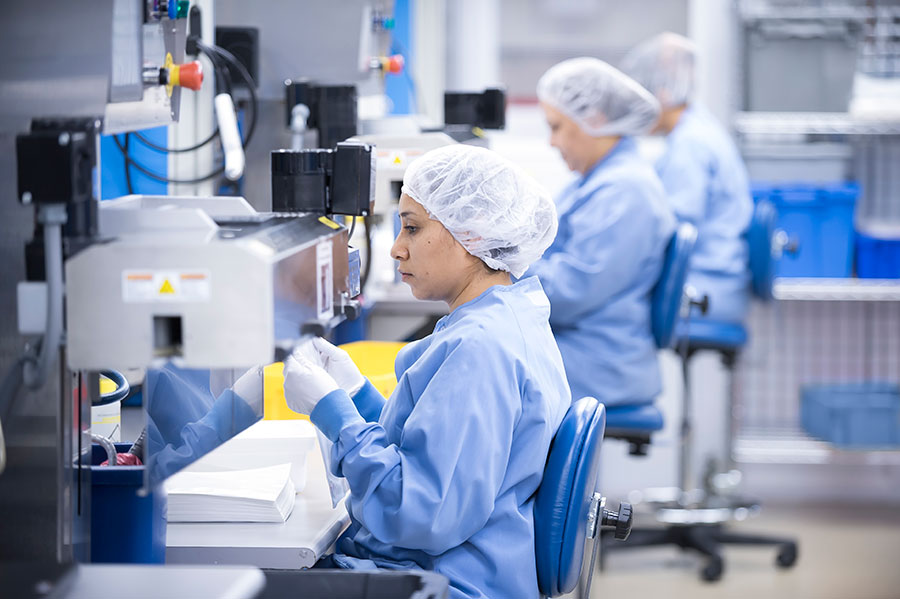
Final assembly of many contract manufactured medical devices must occur in controlled environments. The cleanroom classification, from ISO Class 7 through to ISO Class 5 for the most sensitive applications, is determined by the contamination sensitivity of the device and its intended sterility status. Personnel gowning standards, environmental monitoring schedules, and material transfer protocols all contribute to maintaining the integrity of the controlled space. For implantable and sterile devices, cleanroom discipline is a regulatory requirement whose documentation trails must be complete, traceable, and available for audit.
Sterilisation and Packaging
For sterile medical devices, the sterilisation process, whether ethylene oxide, gamma irradiation, electron beam, or steam, must be validated to deliver a sterility assurance level of 10⁻⁶ or better. The choice of method is constrained by material compatibility, as certain polymers degrade under irradiation while ethylene oxide requires residual testing to confirm safe levels in the finished device. Sterile barrier packaging must also be validated to maintain device sterility through the expected distribution and storage lifecycle, with seal integrity and labelling accuracy subject to documented verification at each production run.
Quality Management and Regulatory Documentation
Underpinning every stage of contract manufacturing of medical devices is a quality management system certified to ISO 13485. This framework governs supplier qualification, incoming inspection, in-process monitoring, non-conformance management, and corrective action. For devices entering regulated markets, the contract manufacturer’s documentation must support the brand owner’s technical file, with full traceability from raw material lot through to finished device serial number. In markets subject to FDA oversight, design history files and device master records must meet additional documentation standards that place further demands on the contract manufacturer’s quality infrastructure.
Selecting a Contract Manufacturing Partner
The selection of a medical device contract manufacturer warrants deliberate attention. Key considerations include regulatory certification scope, cleanroom capability, validated process portfolio, material handling expertise, and demonstrated experience with comparable device classifications. Geographic considerations also carry weight: proximity to key markets, supply chain resilience, and regional regulatory familiarity all influence total programme risk. Singapore has positioned itself deliberately within this landscape, cultivating a manufacturing environment that combines regulatory sophistication, technical depth, and supply chain connectivity across the Asia-Pacific region.
Conclusion
The end-to-end arc of contract manufacturing of medical devices is a sustained exercise in managing complexity under conditions where the consequences of failure are measured not in rework costs but in patient outcomes. Every validated process, every documented inspection, and every cleanroom protocol exists because the device at the end of the line will eventually be used on a person. That is the weight that distinguishes contract manufacturing of medical devices from almost every other form of industrial production, and it is the weight that the best contract manufacturers in the world carry with complete seriousness.